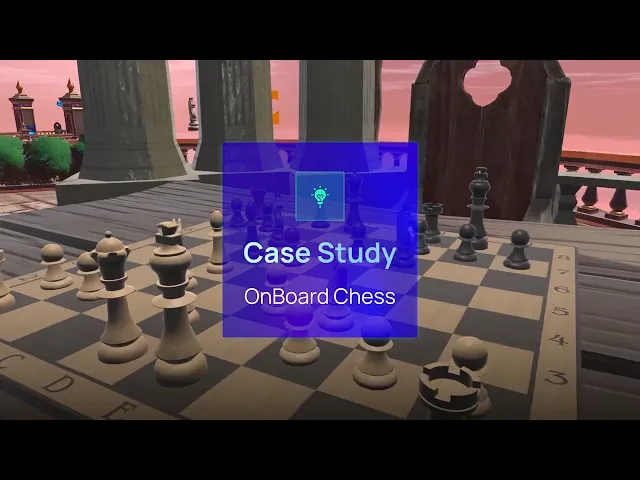

New Case Study: OnBoard Chess

Most VR multiplayer games keep their lobbies small. There’s a good reason.
OnBoard Chess, from Knight Vision Games, works like a chess club in VR. Players walk into an open lobby, pull up a chair at any table, and play whoever is sitting there. They talk across the board with voice chat, or wander between tables to watch other games. More than 30 players can share the room, and the lobby stays open around the clock.
The VR bandwidth problem
In a typical MMO, the server syncs each player’s position and rotation. In VR, it also has to sync each player’s fingers, hands, head direction and eye movement, at 15 frames per second.
According to founder Mustafa Jibin, that’s about 5x the data per player. All of it is egress, which makes it expensive. Many VR studios get around the cost with peer-to-peer hosting, but that doesn’t hold up with a full room of players.
Persistent servers, egress included
Knight Vision Games runs the OnBoard lobby on Edgegap’s Persistent Servers. The server stays up 24/7, and the plan includes enough egress to carry the heavy avatar traffic. Edgegap’s Server Browser adds or removes lobby capacity as the player count changes.
“Edgegap’s persistent server plan, along with the amount of egress data that’s included with it, naturally was a great fit for exactly what we wanted to accomplish.” - Mustafa Jibin, Founder, Knight Vision Games
Read the full story
The full case study covers what the studio needed and how the setup went: OnBoard Chess case study.
Written by
Gabriel Parent (Director)