The Hidden Cost of Studio Engineering: Agones

The free license is the most expensive thing about Agones: it costs $0 to download, which is precisely why its real cost never lands on a budget line and never needs anyone's approval.
$42K to integrate, up to $567K over three years to operate and maintain: the integration is the number studios plan for. Deconstructor of Fun's TCO calculator prices what follows it at 2 to 12 times more.
Agones is not the project, the scaffolding around it is: KRAFTON adopted Karpenter and built a container registry proxy on top of Agones, cutting PUBG session server boot from 15+ minutes to 3 to 4, only part of the additional integrations necessary.
Maintenance outlives the build: the benchmark Yazıcı cites puts annual upkeep at 15 to 25% of build cost, every year, consuming 60 to 80% of total lifecycle cost.
Build cost is not the server bill: orchestration's recurring value is fill rate, and idle capacity is spent whether or not anyone is playing on it.
Aylin Yazıcı, Consultant at Deconstructor of Fun and BD Manager at Ciao Games, published a build-versus-buy breakdown for game studios in July 2026 (The Hidden Cost of Studio Engineering), arguing that internal engineering builds almost always cost more than the studios building them believe, and shipping a total cost of ownership calculator alongside it. She writes from having worked inside studios and led one, plus due diligence on several top free-to-play publishers' central tech teams.
Indirectly, this gives any studio a way to put a number on a decision that usually gets made on instinct. So we ran her calculator on one specific version of it: adopting Agones.
The Accounting Illusion Gets Worse When the Software Is Free
Sega recorded a $200 million impairment write-down on Rovio in its Q3 earnings. Yazıcı opens with that number, and with the observation that Rovio's internal tech team contributed to it. Her other example is Microsoft firing id Software's tech team, the people behind Doom, Quake and Wolfenstein.
Then she describes the meeting every studio has held. The demo goes well, the product is solid, the team that would use it wants it. And then a senior engineer or a CTO says it out loud: "Why don't we just build this ourselves?" The tool is dropped, a project is spun up, and as she writes, "nobody ever runs the math on the actual costs."
Her diagnosis is an accounting one. A license lands on a budget line and requires approval. An internal build disappears into existing salaries and sprint cycles.
"The accounting makes internal builds look free when they are not."
Agones is the version of this with the volume turned up, because the software genuinely is free. There is no quote to compare against, no line item to approve, and therefore no moment where anyone is forced to produce a number.
Agones Is Not the Project. The Platform Around It Is.
Adopting Agones does not mean writing an orchestrator. It does mean operating an orchestration platform, which is how the project describes itself: "open source multiplayer dedicated game server scaling and orchestration platform on top of Kubernetes."
Platform is the operative word. Agones handles GameServer pods, Fleets and the FleetAutoscaler. Everything a platform also needs, you supply: node provisioning and scaling, an image registry and distribution path, monitoring and logging, capacity buffering, secrets, CI/CD into the cluster, state and database access for allocation, alerting, and someone carrying the pager when a fleet stops filling.
PUBG: BATTLEGROUNDS is a useful case because KRAFTON published the numbers. In their AWS re:Invent 2024 session, DevOps Team Lead JungHun Kim broke down session server boot time on Agones into three stages: instance provisioning at 1 to 3 minutes, instance bootstrapping at 2 to 3 minutes, and pod provisioning at 5 to 10 minutes. Total, in KRAFTON's own words: "10~15+ minutes."
Two further projects followed.
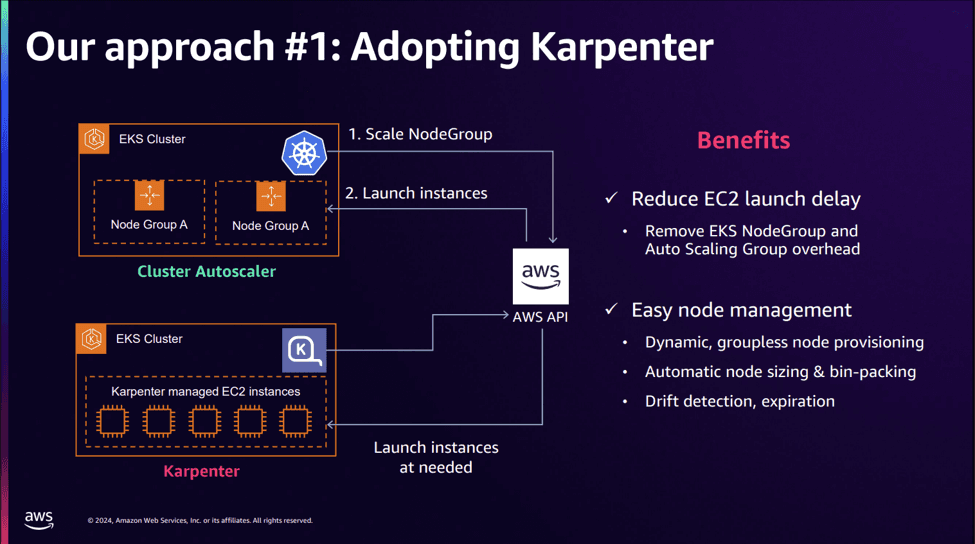
The first replaced Cluster Autoscaler and EKS NodeGroups with Karpenter, to remove Auto Scaling Group overhead and get groupless node provisioning with automatic sizing, bin-packing and drift detection.
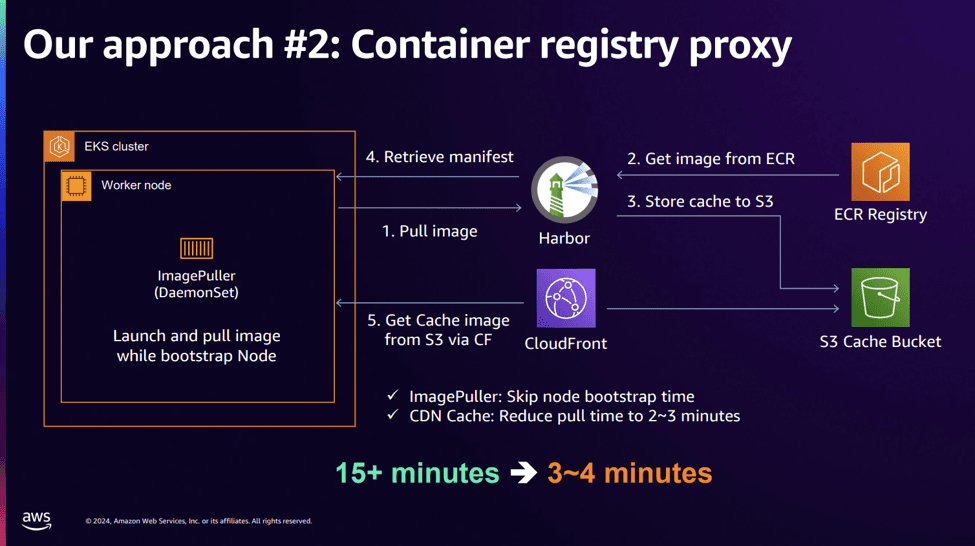
The second was a container registry proxy: Harbor, an S3 cache bucket, CloudFront, and a custom ImagePuller DaemonSet that pulls the image while the node is still bootstrapping. KRAFTON's measured result was pull time down to 2 to 3 minutes and overall boot from "15+ minutes" to "3~4 minutes."
That second project is not configuration. It is an image distribution system, designed and maintained in-house. KRAFTON also listed the trade-offs on their own slide: provisioning concurrency was "difficult to manage," and resources were "unable to adjust dynamically" below Kubernetes 1.32 on EKS.
The orchestrator was the starting point, not the full scope. Edgegap's own breakdown of what running it involves is in The High Cost of Free Products: Agones.
Does It Really Cost $42K to Integrate Agones?
Start with the number a studio would actually write into a plan. $42K.
That is Yazıcı's calculator run on a deliberately modest adoption: one senior developer, one month full-time, two months of lighter integration and testing. Salary set at $135K base/year, which the calculator loads to $169K once the 25% employer-side cost is applied.
That salary is on the high side on purpose. levels.fyi puts median total compensation for a video game software engineer at $96,542 and for a DevOps engineer at $79,296. The skill stack Agones actually demands is Kubernetes, Linux, Docker and containerd, a language like Go or Python, plus networking and security, so we modeled a specialist rather than a median hire. Read the salary as an upper bound.
Then add a DevOps engineer at roughly 30 to 50% of their time once the game is live, and run it over three years:
Line | 3-year cost |
Initial integration (1 senior dev, 3 months) | $42K |
Maintenance (20%/yr) | $25K |
Evolution and new features (15%/yr) | $19K |
Knowledge retention risk | $17K |
$464K | |
Total | $567K |
So the answer to the section title is yes, and it is 7% of the picture.
Two caveats, because they are the difference between a useful number and a marketing one.
First, opportunity cost is the calculator's model, not ours and not a measurement. Yazıcı's own formula, published in the calculator's own methodology: total annual team cost multiplied by the years remaining after the build completes, on the reasoning that an engineer allocated to infrastructure is an engineer not allocated to the game. Challenge the model if you want, but challenge it on those terms.
Second, that line assumes the engineer stays fully assigned. The build takes 3 months, leaving 2 years and 9 months in the window, and the calculator charges the full $169K for each of them. Our scenario only commits 30 to 50% of a person. Scale that line to 40% and the three-year total lands near $289K instead.
What does not change in either version is the first $103K, or the ratio. The integration everyone plans for is $42K. Everything after it is between two and twelve times that. The calculator's own framing is that most companies underestimate by 3 to 5x.
Maintenance Is the Majority of the Bill, Not the Build
This is where most initial project estimates fall apart. "The backend you ship is not the backend you keep." Platforms update, SDKs deprecate, security vulnerabilities emerge, engine versions shift. Google's Play Games Services deprecation schedule is a concrete example of that clock running whether or not a studio is ready for it.
The benchmark Yazıcı cites, which she traces to IEEE research and Gartner analysis, is 15 to 25% of initial build cost annually. Every year. Without end. Across a full system lifetime, maintenance consumes 60 to 80% of total lifecycle cost. The build is the minority of what you spend.
An orchestration platform is a demanding version of this. Kubernetes minor releases arrive on a fixed cadence and drop support behind them, node images churn, CNI and ingress components move, and Agones tracks a supported Kubernetes range of its own. KRAFTON's note that dynamic resource adjustment required Kubernetes 1.32 on EKS is exactly this: a capability gated behind a cluster upgrade someone has to plan, test and execute.
None of it is deferrable, because you cannot skip a security patch on the process that starts your matches. As Yazıcı puts it, "the thing that you buy is already battle-tested by others; the thing you build, well, you are going to be battle-testing it live yourself." Edgegap's guide on hosting scalable game servers with Docker or Kubernetes covers the moving parts in more detail.
Evolution Never Stops for a Live Game
Maintenance keeps the system standing. Evolution is everything the system gets asked to do that it was not built to do.
Live service games do not have stable feature sets, a point Deconstructor of Fun made at length in The Backend Jungle. New monetization models need new logic, new platforms need new integrations, new player behaviors surface new backend requirements. "Every evolution is a mini-build project funded from the same engineering capacity you need for the game itself," as Yazıcı writes.
For orchestration the requests are predictable and endless. A new region. A console launch with different networking rules. Cross-play. A creator spike that arrives on a Tuesday with no warning.
There is also a structural mismatch underneath the workload. As Edgegap's Agones analysis frames it: "Kubernetes was initially made for web-based technologies. They manage thousands of stateless connections, serving small requests for a fraction of a second. Game servers are the opposite of this philosophy. Game servers and relays are stateful, managing persistent connections for 5 to 45 minutes."
What has changed since Agones launched in 2018 is that the container benefits KRAFTON was after, standardization, bin-packing and one deployable unit, no longer require operating the platform yourself. That is the premise of managed orchestration.
Development Is Only Half the Equation
Everything above is the cost of building and running the platform. None of it is the server bill.
That distinction matters because the recurring job of an orchestrator is not deployment, it is fill rate. Servers bill for every hour they exist, not for the players on them. A node running two matches when it could hold six costs exactly what a full one costs, and the difference is money spent on nothing.
Both directions of scaling open that gap. Scaling up happens in whole instances, so the moment demand crosses a threshold you pay for an entire node to serve the overflow sitting on it. Scaling down cannot happen until the sessions already on a node finish, because matches are stateful, so you keep paying while it drains. Slow provisioning widens both: if capacity takes 10 to 15 minutes to come online, you hold a warm buffer to cover the gap, and a buffer is idle by design.
KRAFTON's requirements slide names this directly, listing "resource scaling and buffering to match demands" and "maximizes VM efficiency through resource bin-packing" under cost efficiency, alongside standardization and scalability.
A studio can win the build-versus-buy math and still lose on utilization every month afterward. Provisioning fast enough not to need a standby pool is the argument for just-in-time container orchestration.
The Line Everyone Will Argue About
$464K of the modeled $567K is opportunity cost, and Yazıcı calls it both the highest cost and the one no spreadsheet captures, which makes its inclusion in her own spreadsheet deliberate.
Her argument is not that studios should shrink their engineering teams. It is the opposite. "Your best backend engineers should not be writing matchmaking code that already exists." Orchestration is table stakes. As she writes, "No player ever bought a game because its matchmaking or live ops tools were built in-house."
Where the cost surfaces is in games that ship later, with fewer live ops features, into a market that did not wait. KRAFTON's engineers solved their bootstrapping problem, and solved it well. They also spent that time solving a bootstrapping problem.
For studios pricing the alternative against a six-figure internal line, Edgegap is free to start with a single price across all locations, and setup runs in minutes for developers who know their stack. QLOUD Games moved Loftia's game server hosting and orchestration to Edgegap in under 24 hours.
Yazıcı's closing reframe is the one that travels: "Buying infrastructure is a capital allocation decision. And like any capital allocation decision, it deserves rigorous analysis rather than a gut default to 'we have the engineers.'"
—
This article is based on and cites the original article by Aylin Yazıcı, published on Deconstructor of Fun, and the AWS re:Invent 2024 presentation "The evolution story of game architecture: PUBG: BATTLEGROUNDS" by JungHun Kim, KRAFTON. All rights in the original content are owned by their respective owners.