Agones
Agones is an open-source platform for running and scaling dedicated game servers on Kubernetes, originally built by Google and Ubisoft. It adds game-specific concepts to Kubernetes (server lifecycle, allocation, fleet autoscaling) through custom resources, and requires integrating its SDK into your server build. The software is free. Operating it is not.
,
What Does Agones Add to Kubernetes?
Kubernetes was built for workloads it can stop, move and replace whenever it needs to. A web server pod that disappears costs a few retried requests. A game server pod that disappears mid-match ends the match for everyone on it.
Agones teaches Kubernetes the difference. Your server build integrates the Agones SDK and reports its own state: Ready when it can take players, Allocated once a match is assigned to it, Shutdown when the match ends.
Agones then works around those states. A Fleet keeps a pool of Ready servers, a FleetAutoscaler resizes that pool against demand, and an allocation hands a Ready server to your matchmaker and marks it Allocated. Scaling down or rolling out a new build leaves Allocated servers alone, so players are never removed from a match in progress. A server that stops sending health pings is marked Unhealthy and replaced.

In Practices - Insights from Edgegap's Blog
Article's key insights
Infrastructure Modernization Objective: KRAFTON aimed to eliminate operational bottlenecks and improving scalability for hundreds of thousands of concurrent players across global regions by switching from session-based game server to modern container-based game server orchestration.
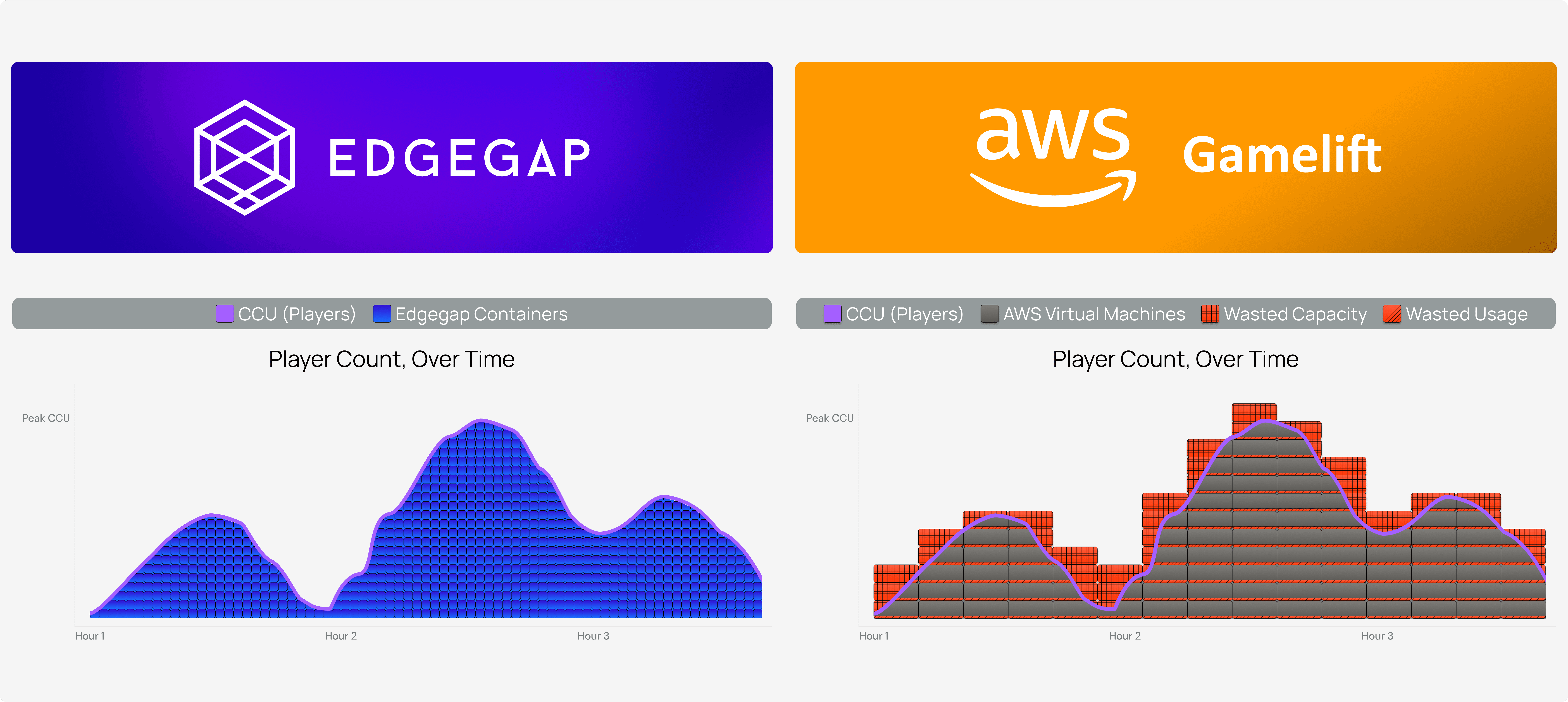
Agones Scaling Limitations: The open-source game server orchestration platform suffered from 15-minute bootstrapping delays during peak scaling events. KRAFTON's engineering team invested heavily in custom solutions to reduce this to 3-4 minutes through container registry proxies and Karpenter adoption. Whereas developers can simply use a fully managed solution like Edgegap which boots game server from cold start in 2 second median (October 2026, /platform-data/).
Operational Efficiency Benefits: Containerization reduced environment provisioning to under 5 minutes and enabled self-service capabilities. Teams gained autonomous access to testing infrastructure without DevOps intervention.
Hidden Resource Impact: The modernization journey consumed years of specialized engineering effort that could have been directed toward gameplay improvements. Most studios cannot afford this level of infrastructure investment while maintaining competitive development cycles.
Managed Platform Alternative: Fully managed solutions deliver equivalent, if not better, performance and scaling capabilities without internal complexity. Studios achieve enterprise-grade infrastructure through simple integration rather than multi-year implementation projects by using a platform like Edgegap.
What Does Running Agones Involve?
Agones is one component of an orchestration platform, and installing it on a cluster is the quick part. The work sits around it: provisioning nodes fast enough to meet demand, getting server images onto those nodes, running capacity in every region your players connect from, connecting allocation to a matchmaker, monitoring, upgrades that keep pace with Kubernetes releases, and someone on call when a fleet stops filling.
KRAFTON's PUBG: BATTLEGROUNDS is the most detailed public example (AWS re:Invent 2024, GAM311). Session server boot on Agones took 10 to 15+ minutes across instance provisioning, instance bootstrapping and pod provisioning. Two further projects, Karpenter for node provisioning and a Harbor registry proxy with a CDN cache, brought it to 3 to 4 minutes.
KRAFTON started that work with advantages most studios don't have:
Scale. A top-3 game on Steam by current players at the time, with 100-player matches and a target of hundreds of thousands of sessions.
A team already running Kubernetes. QA and lobby services moved to Amazon EKS under a dedicated DevOps team, and the session servers shared that platform.
Time. The migration ran from November 2018 to June 2023.
Direct vendor support. AWS solutions and account staff co-presented the session, which describes operational reviews, major-event planning and roadmap meetings with AWS.
With all of that in place, KRAFTON credited the setup with keeping the operational load to a small number of DevOps engineers.
When Is Agones the Right Choice?
Agones fits studios that want full control of their orchestration, need servers to stay inside their own cloud account, or already have people who operate Kubernetes and the platform around it. It's open source, and it runs anywhere Kubernetes runs.
The trade-off is reach as much as effort. A studio-run cluster covers the regions that studio provisions and pays for. A shared network pools capacity across many studios: Edgegap's spans 615+ locations across 17+ providers (platform data, as of 18 September 2026), a footprint a single studio rarely builds on its own.
To weigh the two side by side, see Edgegap vs Agones. Our migration guides show what moving to Edgegap from another platform involves.


A word from our sponsor (ourselves!)
A region is a guess about where your players will be. Edgegap's Edge Cloud is a distributed, multi-cloud network of 615+ locations across 17+ providers, available on demand. Each server launches at the best available location on the network when the match starts, not at the nearest of a handful of regions.