Auto Scaling
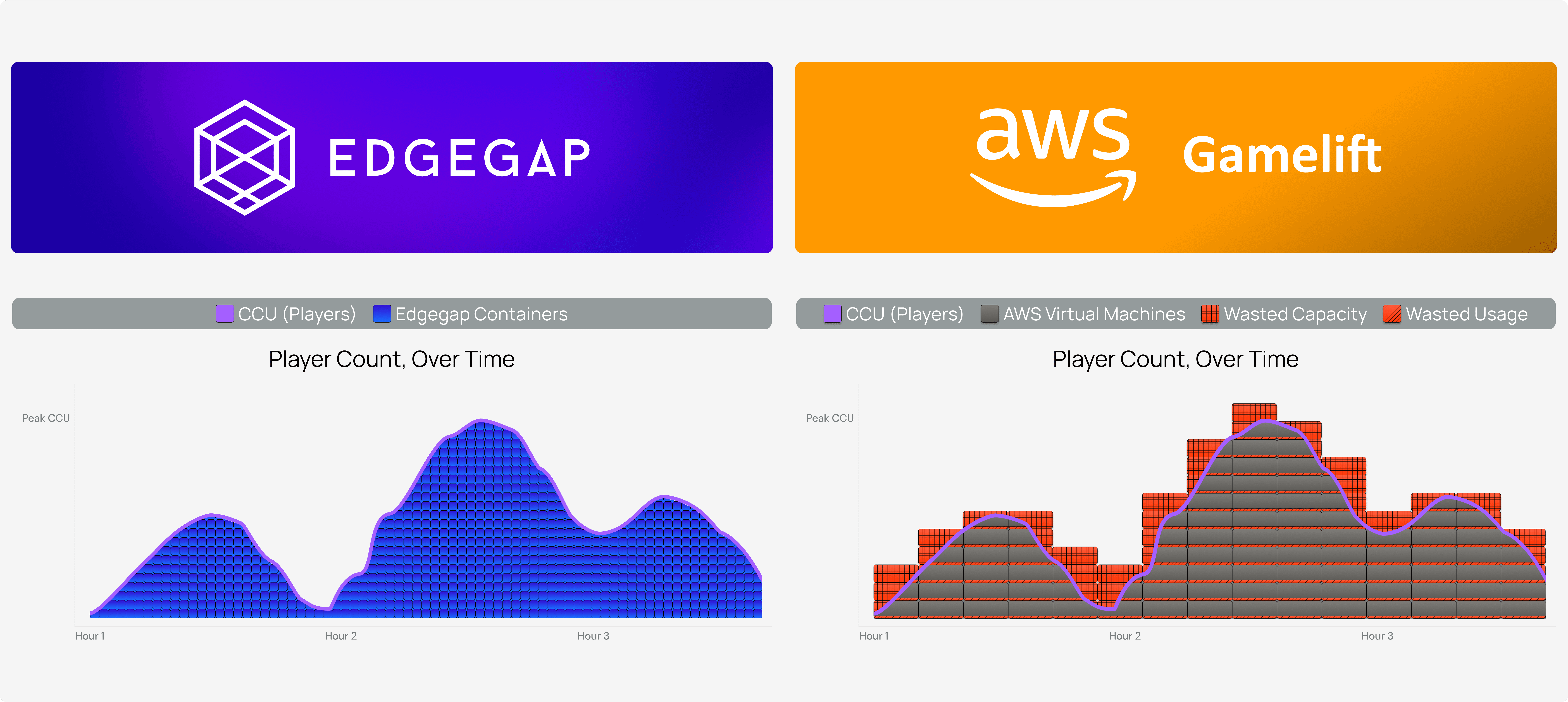
Auto scaling adds and removes game server capacity automatically as player demand rises and falls. The policy decides when to start servers, how much headroom to hold ahead of demand, and how quickly to release capacity afterwards. Tuned well it is invisible; tuned badly it produces either queues or idle machines.
Also called
autoscaling
,
What Does Auto Scaling Scale in a Multiplayer Game?
In a multiplayer game, the unit of demand is a match. Players queue, the matchmaker groups them, and the group needs a server.
A match holds live state, and it can't be split across servers or moved mid-game without players noticing. So the number that matters is not how busy servers are. It's how many more matches they can take. A server at 30% CPU with a full match can't take another one. That's why game server scaling usually watches free capacity: open match slots, or servers ready and waiting.
That capacity comes two ways. Hold a fleet of machines and scale it ahead of demand, or start a server for each match when the match asks for one, which depends on how fast a server starts (its cold start).
What Does an Auto Scaling Policy Decide?
More than how many. A policy decides when capacity is added, how much, where, and when it's given back:
Headroom: Free capacity held ahead of demand, to cover matches that arrive while new capacity starts.
Thresholds and limits: What triggers a change, and the minimum and maximum it can't cross.
Location: Peaks move with the time zones. Capacity in the wrong place shortens nobody's queue, and a server far from its players plays worse. Scaling goes up and down, and also out, across locations and the networks that route players to them.
Release: How quickly capacity is given back once demand falls.
None of these is set once. Request rates, start times, match lengths and player latency keep moving, so at scale a policy is a stream of decisions made from live data.
Both failure modes in the definition leave a signature. Queues at peak mean capacity arrives too late or in the wrong place. Idle machines in the trough mean it leaves too late. The second is easier to miss, because no player reports it.
Why Is Scaling Down Harder, and Costlier, Than Scaling Up?
Scaling up adds a server. Scaling down has to wait for one to empty.
A machine hosting several matches can only be released when its last match ends. Matches finish at staggered times, so after a peak, machines drain partly empty. That idle tail is paid capacity hosting nobody, and a persistent world may never drain at all.
The two ways to shorten the tail each have a cost:
Packing. New matches go to the fullest machines first, so the emptiest drain sooner.
Ending matches early. That ends them for the players, which is why scalers usually offer protection for running matches.
Fitting matches onto machines so they empty cleanly is Tetris-like work, played around the clock. With self-hosting, the studio's developers build and tune it. With orchestration, it's automated: hybrid providers pair reserved capacity for the steady load with on-demand capacity for the peaks, which starts and stops with its matches. Whether building it in-house is worth the development time is a cost question, and the pricing page puts a number on the ready-made side.
How Does Server Start Time Change Auto Scaling?
Headroom exists because new capacity takes time. When a server takes minutes to start, a policy holds minutes of demand in reserve, in every location.
When a server starts in seconds, a match can get one when it asks. Headroom becomes reserved capacity: a cost decision, worth holding where it stays busy. It helps the other half too. A server started for one match stops when that match ends, so there is no tail to drain. Most games combine both: a baseline sized to steady load, everything above it on demand (hybrid orchestration).
On Edgegap's Edge Cloud, servers start in a median of 2 seconds, and the platform sustained 40 deployments per second over a 60-minute benchmark (platform data: rolling 30 days to 18 September 2026; November 2023). Match-bound servers stop on match end, billed per minute.
Studios wanting to optimize between cost-efficient reserved capacity (Private Fleets, 58 locations) and on-demand capacity (Edge Cloud, 615+ locations worldwide on-demand) can do with Edgegap's hybrid orchestration.


A word from our sponsor (ourselves!)
Launches and viral spikes don't arrive one server at a time. In a 60-minute benchmark, Edgegap started 40 game servers every second for the full hour, across 550+ locations and 17 providers, so a surge of players turns into matches played online, not a long queue of players waiting.
Edgegap's Take (just our opinion, take it with a grain of salt!)
Scaling Up Is Only Half the Decision
Every orchestrator scales up. Two other questions decide whether it suits your game.
Where does new capacity land? Scaling has to follow players by location and network route, in real time, as the peak moves.
How quickly does it stop? Capacity that outlives its match is billed with nobody on it.
Edgegap answers both per match. Each deployment goes to the best available location on the Edge Cloud network at request time, starts in a median of 2 seconds, and stops when the match ends. Studios with steady load reserve Private Fleet hosts and burst to Edge Cloud above them.
Ask any provider both questions, with numbers, for your peak hour and the hour after it.
,