Client-Server Architecture
Client-server architecture has every player connect to one central server that owns the match state, rather than to each other. The server receives inputs, advances the simulation and broadcasts the result. A server costs money to run, but it can help any type of game be fairer, more consistent and more secure, for every player.
Also called
client server architecture, client-server model, client/server
,
How Does a Client-Server Game Loop Work?
Client-server describes the shape of the network. Each player's game, the client, opens one connection to the server rather than to other players. The server keeps the match state: the one version of events every client defers to.
One cycle of the loop looks like this:
Each client reads its player's input and sends it to the server.
The server collects the inputs that arrived since its last update.
It advances the simulation: movement, physics, hits, scores.
It sends the new state back to every client.
Each client draws that state, and the cycle repeats, often dozens of times a second.
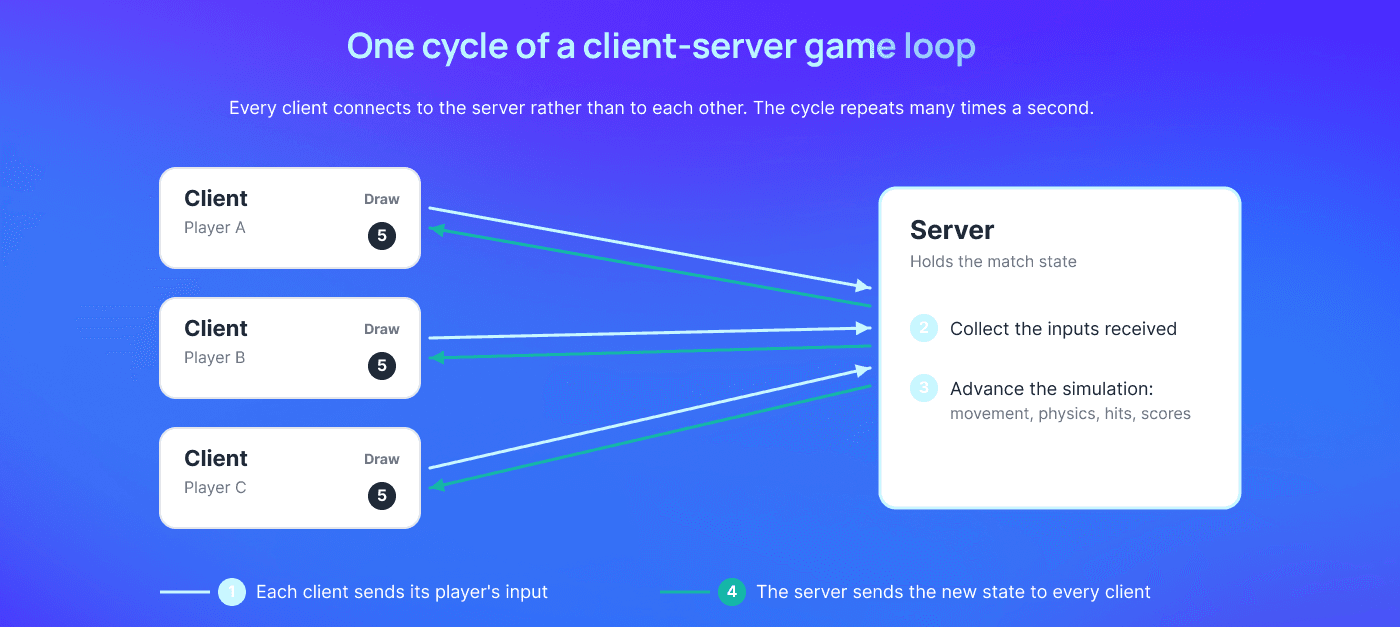
The shape doesn't say which machine plays the server: one player's game on a listen server, or a process nobody plays on, a dedicated server. Both are client-server. How much the server decides is a separate question, covered under authoritative server.
Why Do Client-Server Games Predict and Interpolate?
Routing everything through one point has a built-in cost: every action makes a round trip before the server confirms it. On Quake (1996), John Carmack wrote that his design "was targeted at <200ms connection latencies," while modem players saw "300+ ms latencies, minimum" (development log, 2 August 1996). His fix for QuakeWorld let the client guess the result of its own movement until the server's answer arrived.
That fix became a pattern. Many client-server games now layer three techniques on top of the shape:
Client-side prediction shows your own actions at once, then corrects them if the server disagrees.
Interpolation draws other players between two updates already received, so their motion is smooth but slightly in the past.
Lag compensation lets the server rewind to what a shooter saw when it checks a hit.
The result is that no two players see the same moment. Your own character runs a little ahead of the server, everyone else a little behind it, and only the server's version counts. A player who swears they shot first can be right about their own screen.
The delay these techniques hide can still be large. Roblox's documentation tells creators that most players see 100 to 300 ms of network latency (Roblox docs, read 8 October 2026).
Is the Game Server the Only Server?
Software courses teach client-server in two or three tiers. A multiplayer game usually runs more than one kind of server at once:
The match server holds the live state of one match or one world in memory, and keeps every connected client in sync for as long as it runs.
Backend services, such as accounts, matchmaking, inventories, leaderboards and storage, keep the data that outlives the match.
Roblox splits it the same way: its servers run each experience's live state, while data stores hold progress, inventories and leaderboards between sessions (Roblox backend deep dive, November 2023).
The tiers fail differently. A match server that crashes ends its own match. A shared service that fails can stop every match from starting. Roblox's 73-hour outage in October 2021 began in Consul, a system its backend services used to find each other, and took the whole platform down (Roblox, 20 January 2022).
What Does a Client-Server Model Cost?
The hub is where the costs gather, on top of the hosting bill that peer-to-peer moves onto players' machines.
Bandwidth. Clients upload small inputs and download the world. The server sends every player's state to every player, so its outgoing traffic can grow with the square of the player count (Construct's multiplayer guide, updated September 2023). Interest management, sending each client only what is relevant to it, keeps large matches in check.
Failure. A crashed server takes its match with it. A server per match limits that to one match. A persistent world drops everyone on it.
Distance. Every player's latency is their distance to the same hub, so the server's location is the one variable the whole match shares. A server placed near one group of players puts the rest further away.
Each of these costs has an infrastructure answer. Edgegap's Private Fleets are bare metal hosts with egress included, which takes the bandwidth bill off the meter. One container per match keeps a crash inside its own match. And Edge Cloud places each match from its players' locations, on a network of 615+ locations, choosing the best location with capacity at request time.


A word from our sponsor (ourselves!)
Most lag comes from distance, not from code. Edgegap's Edge Cloud is a distributed network with up to 615+ locations available on demand, so each match runs at the best available location for its players. Independent replays of live studio traffic measured a 58% drop in average round-trip time compared with public cloud.
Edgegap's Take (just our opinion, take it with a grain of salt!)
Where the Server Sits Is a Balance
Client-server gives every player one connection, and all of them lead to the same place, so the server's location is part of the game's design. It is also a balance. Players tend to cluster around large population centers, where steady demand makes fixed capacity cost-effective. Others play further out, and demand peaks at some hours and fades at others.
That is why most games end up hybrid: Private Fleets for the steady demand near those centers, and per-match placement on Edge Cloud for players further out and for the peaks (server regions covers the trade-off). Placement pays off: independent replays of a studio's live traffic measured a 58% average latency reduction for dedicated server placement against public-cloud relay placement (platform data, 18 September 2026).
A useful check: find the player in a typical match who sits furthest from the server, and ask whether the location was chosen for them, or only for the players near the center.
,