Noisy Neighbor
A noisy neighbor is another tenant on shared hardware whose load can slow your workload down when the host does not hold each tenant to its own limits. In game hosting, it is the argument most often made for moving servers onto whole machines: owned hardware, rented bare metal or hyperscaler cloud instances. On a container host that enforces CPU and memory budgets, each game server keeps the resources it was given: a neighbor that exceeds its budget is throttled or stopped, and only its own match is affected. The neighbors thus remain unaffected.
Also called
noisy neighbor, noisy neighbour
,
Is Noisy Neighbor Only a Shared-Cloud Problem?
Noisy neighbor is usually raised as a reason to leave shared capacity for whole machines. Some bare metal providers put it at the centre of their pitch: "For a game server, a noisy neighbor can cause inexplicable lag spikes, slower tick rates, and inconsistent gameplay" (Hivelocity, December 2025).
The argument skips one detail. A game server host rarely runs a single match. A bare metal machine with dozens of cores often runs dozens of matches side by side, and each of them is a neighbor to the others. The studio owns all of them, but the contention it set out to escape is still on the machine, now coming from its own busiest match.
So the question is not whether a host is shared. Every orchestrated fleet shares its hosts, even when one studio owns all the capacity. The question is whether each server on the host is held to its own budget.
Can a Noisy Neighbor Slow Down Your Game Server?
Not on a container host that enforces limits, whoever the neighbor belongs to, including your own studio. When a match's server starts, it is given a CPU and memory budget, and the host's kernel holds every container to its own through control groups (Docker documentation).
CPU. A neighbor that tries to use more than its share is held to its limit. It cannot take the CPU your server was given.
Memory. A neighbor that goes over its memory limit is stopped. Its match ends; yours keeps running.
For a game server, the budget that matters is time per tick. A 128 Hz server has about 7.8 milliseconds to finish each tick. With an enforced allowance, that window depends on your server's own budget and code, and stays the same whatever else the host runs.
So if tick time climbs under load, the first place to look is your own server's limit: a CPU allocation set before the last content update, or a memory limit sized for an average match rather than a full one. Colocation covers sizing it.
What Does It Cost to Avoid Neighbors?
Moving to whole machines does not remove neighbors; it only makes them your own. What it changes is the bill:
Idle capacity. A machine held alone is paid for between peaks, overnight and after launch week. The busy-hours arithmetic on bare metal server applies.
Fewer locations. Every region added means another machine sized for your own peak, so studios that keep machines to themselves tend to serve fewer regions, and more players connect from further away.
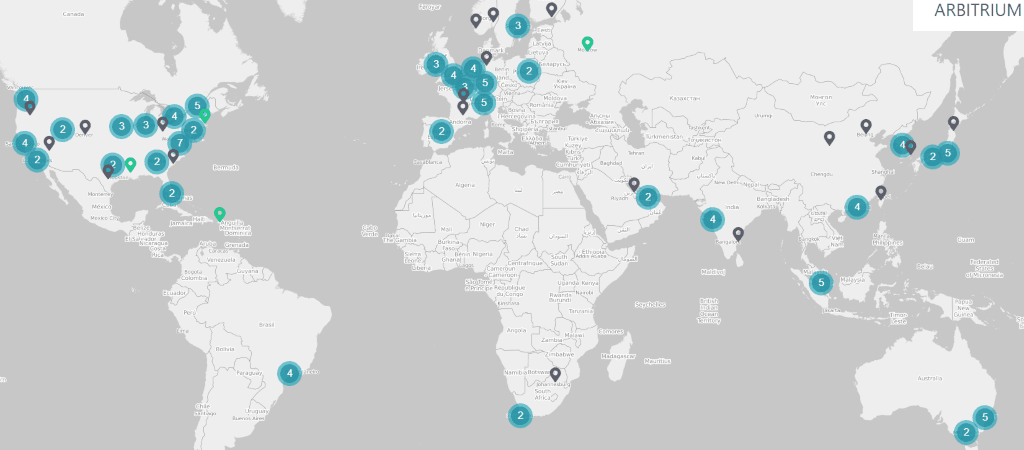
Shared, orchestrated capacity spreads both costs across every game using it, and still holds each server to its budget. Edgegap's Edge Cloud runs every game server in its own container with strict CPU and memory limits, so a neighbor's load stays inside the neighbor's budget. It runs in 615+ locations across 17+ infrastructure providers, billed at $0.00115 per vCPU per minute (platform data, 18 September 2026).
Do the Largest Fleets Share Hosts?
Yes. In Google's Borg, 98% of the machines in shared cells run production and batch tasks side by side, every task "inside a Linux cgroup-based resource container", and latency-sensitive tasks can reserve entire physical CPU cores (Verma et al., EuroSys 2015).
Heracles, also from Google, ran latency-critical services, including web search, on hosts shared with batch work. It reached "average server utilizations of 90% without latency violations across all the load and colocation scenarios" (Lo et al., ISCA 2015).


A word from our sponsor (ourselves!)
A region is a guess about where your players will be. Edgegap's Edge Cloud is a distributed, multi-cloud network of 615+ locations across 17+ providers, available on demand. Each server launches at the best available location on the network when the match starts, not at the nearest of a handful of regions.
Edgegap's Take (just our opinion, take it with a grain of salt!)
Isolation Is the Product
We deploy game servers to millions of players daily (Edgegap internal figure, Q3 2026), with 135 million deployments since February 2019 (platform data, 18 September 2026). Every server runs inside its own CPU and memory budget, on hosts shared with other matches and other studios' games. A neighbor cannot take that budget; its load stops at its own.
So when a studio tells us a match stuttered under load, we look at that studio's server budget first. A memory limit sized for a quiet match, or a CPU allocation set before a content update, is where tick time usually moves.
Sharing is what puts a small game's servers close to its players, billed by the minute. Isolation is what keeps each match its own, with zero impact on every other game using Edgegap's orchestration.
,