Server Allocation
Server allocation is the step where a ready match is bound to a specific game server instance in a specific location. The matchmaker decides who plays together; allocation decides where they play. Get it wrong and a perfectly matched group plays with avoidable latency.
Also called
allocation
,
Where Does Server Allocation Fit in a Match's Lifecycle?
Allocation is the handoff between two systems. The matchmaker's job ends when it has a group of players. The infrastructure's job starts when that group needs somewhere to play.
The match forms. The matchmaker settles on the players, the mode and often the map.
The request goes out. It carries what placement needs: the players, their IP addresses or measured latencies, and the build version their clients run.
A server is bound to the match. Either one already running is claimed, or a new one is started for it.
The server learns its match. The match ID, the teams and the expected players reach the server, so it knows whom to admit and what to load.
Players get an address. Each client receives the server's IP address or hostname and port, and connects.
The server is released when the match ends, back to a pool or shut down.
Steps 2 to 5 often take a few seconds, spent on a matchmaking screen. With the latency it decides, that wait makes allocation the part of the infrastructure players feel most.
In Practices - Insights from Edgegap's Blog
Article's key insights
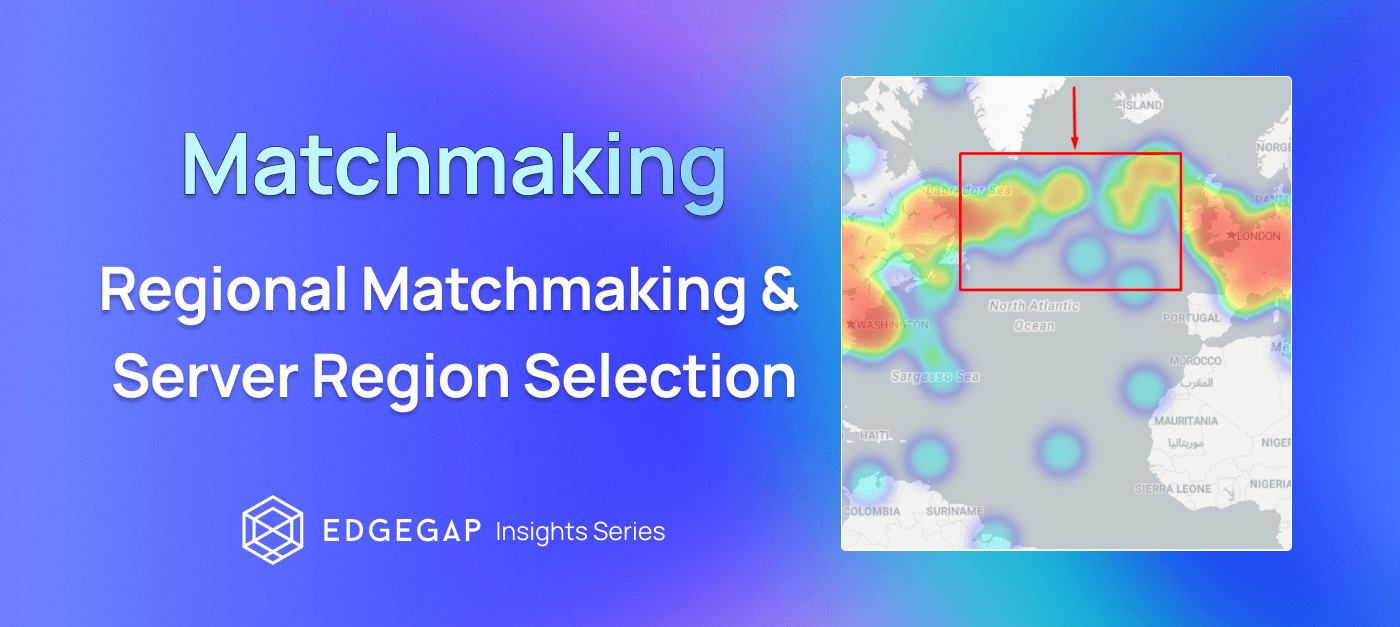
Region selection is a player complaint, not a feature request: When players ask to pick their server region, they are reporting a latency problem they cannot see or control. The feature they request is one possible answer, and on a smaller playerbase it trades bad matches for unfilled ones.
Latency-based grouping solves the issue that region locking attempts to mitigate: Regions are administrative boundaries. Latency is measured. Grouping players by measured ping keeps distant players out of the same lobby without partitioning the queue by geography.
Relaxing rules over time is the lever most matchmakers underuse: Activision's published research loosens skill constraints faster than connection constraints as queue time grows. The same graduated approach applies to any pooling rule.
Queue time is negotiable when the tradeoff is visible: Players in several communities volunteer to wait longer for better connection or a more filled match. The waiting is not what frustrates them. Not knowing what it buys them is.
Transparency and agency shorten the feedback loop: A visible ping figure and an opt-in to wait for a closer server turn vague blame into something a player can act on, at the cost of exposing numbers you may not want exposed.
Claim a Ready Server or Start a New One?
There are two ways to complete step 3, and the bigger difference between them is not speed. It is when the location gets decided.
Claim a ready server. A pool of servers is already running, each waiting in a ready state. Allocation marks one as taken and hands out its address. The location was fixed when the pool was filled, before any of these players queued.
Start a server for the match. Nothing is waiting. Allocation picks a location for this group and starts a server there, so the time it takes is the server's cold start. The location is chosen after the players are known.
Claiming feels instant while the pool holds servers in the right place. When it runs dry, or holds them in the wrong city for this group, the match waits for a refill or plays somewhere less suited to it. Warm pools covers what holding that capacity costs.
Knowing the players also changes what "the right place" means: placement for a group weighs every player's latency, not only the first player's (server regions compares it with assigning a region up front).
Why Does Server Allocation Fail?
Players know this step by its error message. "Server allocation failed" comes up often enough in such games as Gears 5 and Forza Motorsport that players search for it. Behind the message, the causes are usually few:
No capacity where the request asked. The pool for that location is empty, or the location has no room for a new server.
No server running the match's build. On patch day, a client on the new version needs a server on the new version, and the reverse. Until both sides of the update have capacity, some requests have nowhere to go.
The server wasn't ready in time. A large image that isn't cached on the host, or a slow game start, can outlast the request's timeout.
A well-built allocation flow treats failure as a normal branch rather than an exception. It retries a limited number of times, falls back to another location or provider, and keeps the players' place in the queue instead of sending them back to the start. Clients retry the connection for a short window too, because an address can arrive while the server is still starting.
Can Players Be Allocated to a Server That's Already Running?
Allocation isn't only for new matches. These cases send players into a server that's already running:
Backfill fills seats that open mid-match when a player leaves. The running server asks the matchmaker for players, which reverses the usual direction of the request.
Multi-room servers host many small matches in one process, so a new match is allocated a room rather than a whole server.
Seat-based sessions, common in social hubs and persistent worlds, hand a player a place on a server until they leave.
In each case the allocator tracks capacity inside servers, not only servers. A server with two free seats can take a party of two but not three, so this bookkeeping decides how full servers actually run, and with it the session fill rate.


A word from our sponsor (ourselves!)
Launch day is a bad time to discover an orchestrator's edge cases. Edgegap's automated orchestration has run 135 million game server deployments since February 2019 across its distributed, multi-cloud network, and today deploys on behalf of thousands of games and multiple millions of players daily.
Edgegap's Take (just our opinion, take it with a grain of salt!)
Remember to Plan for the Allocation That Fails
Most allocation numbers teams track describe the allocations that worked: how fast a server started, how quickly a pool handed one out. Players also live through the ones that didn't.
So decide before launch what happens on each failure in "Why Does Server Allocation Fail?" section: how many retries, which location or provider comes next, whether players keep their place in the queue, and what they see while it happens. Then measure the share of formed matches that end with every player connected, at peak rather than on average. If nobody can produce that number, the failure path hasn't been tested yet.
Edgegap's platform data counts 135 million deployments since February 2019, including those that failed to start (platform data, 18 September 2026). Fallback also needs somewhere to go: Edgegap spans 615+ locations across 17+ providers, with automatic failover between them.
,