Serverless Game Server
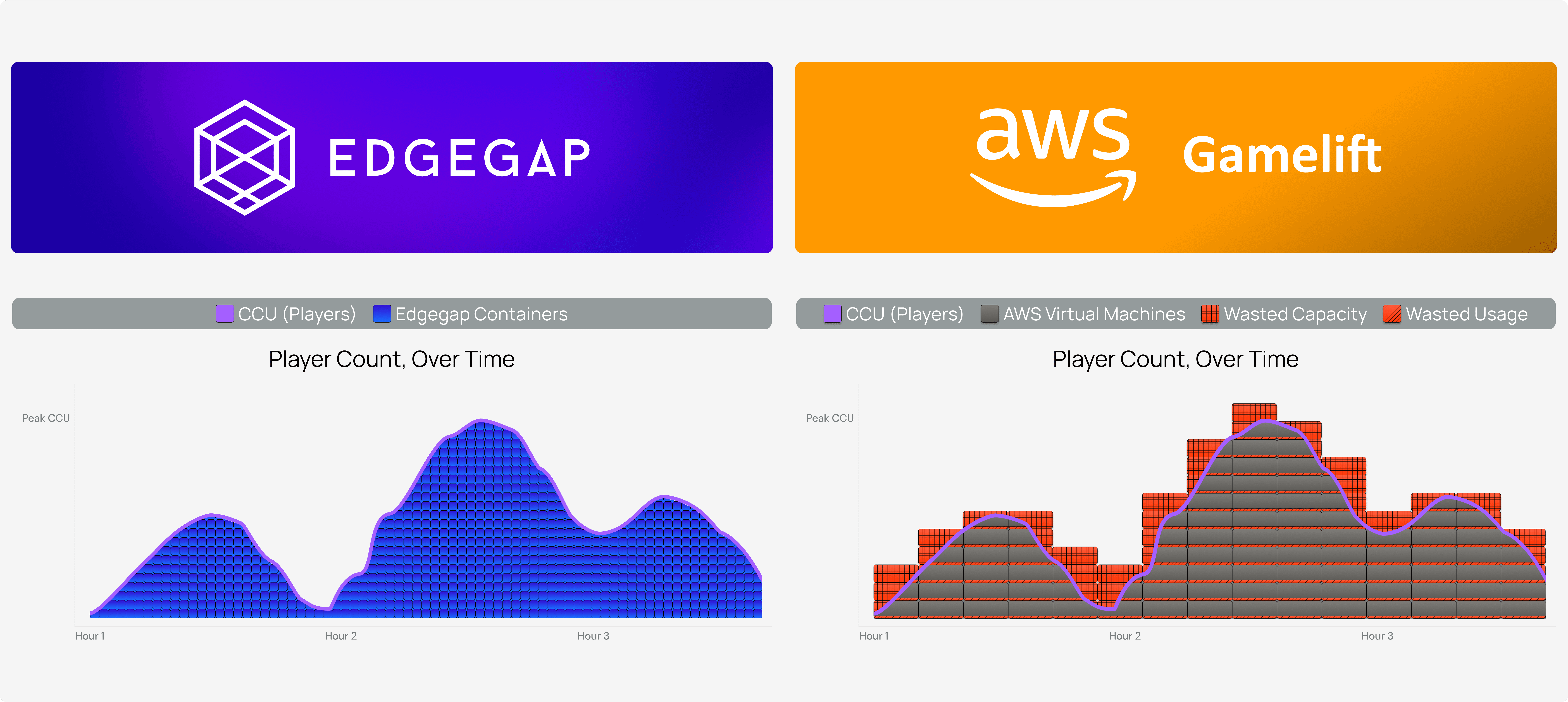
A serverless game server model provisions compute only for the life of a match, with no long-running reserved machines behind it. Capacity appears when a match starts and disappears when it ends, so you pay for matches rather than for uptime. It depends on cold starts being fast enough to go unnoticed.
Also called
serverless, serverless multiplayer, on-demand game servers
,
What Does "Serverless" Mean for a Game Server?
Strictly, nothing is serverless: any code that computes runs on a server somewhere. The word means you don't manage it. In multiplayer it covers three setups, and only one of them runs the match on a dedicated server:
Serverless functions (FaaS). The most common meaning: short-lived, stateless code that runs per request, such as AWS Lambda. They fit a game's backend services: sign-in, leaderboards, notifications. A match needs a process that keeps its state and holds players' connections for its whole length, which functions aren't built for.
Serverless game servers. A dedicated server per match, started on demand when the match needs it and stopped when it ends. Container platforms that start a container on request are often called serverless too; this applies that model to a match. The studio provides the server; the platform runs the machines. This is the meaning on this page.
No server to run. A relay or peer-to-peer setup, where one player's machine hosts the match and the service only connects players. It removes the server, and server authority with it.
Teams often default to the third because a server per match sounds expensive. Multi-room servers change that sum: many matches share one server, at a cost close to a relay's, and the server still holds the state.

What Are the Parts of a Serverless Multiplayer Architecture?
Six parts, each with one job:
Matchmaker or lobby. Groups players and asks for a server.
Orchestrator. Picks a location, starts the server and returns its address. See game server orchestration.
Server image. The headless server build, packaged as a container and stored in a registry.
Game server. One per match, or one per set of rooms, running for the match and stopped after it.
Backend services. Everything outside the match, such as accounts, inventory and leaderboards, often built as serverless functions.
Telemetry and logs. Sent out before the server stops, since its container goes with it.
The platform takes parts 2 and 4: placement, start, scaling and teardown. The studio still owns the server build, a small integration so the server reports when it's ready and when the match is over, and getting its data out.
What Makes Serverless Game Servers Work?
Two things: fast starts and billing by use.
Fast starts. Every match waits for its server, so the cold start is the players' wait. When starts take minutes, platforms hold servers in advance, and the idle cost serverless was meant to remove comes back as a warm pool. On Edgegap's Edge Cloud, a game server starts in 2 seconds, median, measured to container ready (platform data, 18 September 2026), so each match can get its own server on request.
Billing by use. Paying per minute ties cost to matches played rather than machines rented: a server that isn't running costs nothing. As an estimate, a 20-minute match on a 2 vCPU server costs 2 × 20 × $0.00115 = $0.046 on Edge Cloud (same source). Light games go further on a multi-room server, where each match uses a fraction of a vCPU: about $0.001 per match in the multi-room estimate.
When Is Serverless Not the Right Fit?
When the load never stops. A minute on demand costs more than a busy minute on a reserved host, so:
Persistent worlds that run for weeks need a home that stays up.
Steady baseline load, the matches running at every hour, costs less on reserved capacity.
Always-on services, such as a matchmaker or a server browser, have to answer players at any moment, so they run continuously rather than per match.
The match loop itself doesn't belong in serverless functions, for the reasons in Part 1.
Most games have some of each: a reserved baseline, with serverless game servers for everything above it. That is hybrid orchestration.


A word from our sponsor (ourselves!)
Warm pools make allocation fast because you pay for servers that sit idle. Edgegap provisions a fresh game server in a median of 2 seconds from cold start, measured to container ready before your engine starts, so a server exists only once a match needs one.
Edgegap's Take (just our opinion, take it with a grain of salt!)
What Serverless Promises, for Game Servers
Most of the time, "serverless" means functions: short tasks, no server to manage, a bill that follows use. Studios want the same from their game servers: no machines to look after, capacity when players arrive, and costs that follow play.
A dedicated server running game logic asks for more than a function gives. It keeps the match's state, holds every player's connection for the whole match, and plays best close to those players. Edgegap is built to deliver what serverless promises for that kind of server, across genres and game sizes, and from a fraction of a vCPU to a whole host.
,