Game Server Hosting
Game server hosting is the provision and operation of the machines that run a multiplayer game's authoritative server processes. It covers where servers physically sit, how they start and stop, how capacity tracks demand, and what that costs. It is infrastructure, and distinct from the netcode running on top of it.
Also called
server hosting
,
What Does Game Server Hosting Actually Include?
Game server hosting is not one purchase. It is four layers stacked on each other, and every provider sells a different slice of the stack.
Machines. The hardware the servers run on: physical bare metal, virtual machines in a cloud, or both.
Placement. Which locations those machines sit in, and which one each match is sent to.
Orchestration. The software that starts a server when a match forms, stops it when the match ends, and keeps capacity in line with demand.
Operations. Everything that keeps the rest running: patching, monitoring, DDoS protection, and someone on call when a region goes down at 3 a.m.
A public cloud sells you the machines and leaves the other three to you. A managed host adds operations.
An orchestration platform runs the logic across machines and locations. Two offers called "game server hosting" can cover very different parts of this list, which is why comparing them on price alone rarely works.
The real decision is which layers you own and which you rent.

Where Should Game Servers Run?
Two choices sit here, and players only feel one of them.
The machines. Bare metal gives you a whole physical server: the most performance per dollar when it is kept busy, and a fixed monthly cost whether it is or not. Cloud virtual machines start and stop on request and are billed for the time they run, at a higher price per core. Most hosting at scale ends up using both.
The placement. Players never see your hardware. They feel distance, and the distance they feel is the route their traffic takes, not the line on a map. There is no direct route on the internet. Providers hand traffic along the path that is cheapest for them, which is often not the fastest. Riot Games traced one player's connection from San Francisco to Portland through Los Angeles, Denver and Seattle: 70 milliseconds instead of a possible 14 (Riot Games, November 2015). See routing for how paths are chosen. A server in one region sets a latency floor for faraway players that no hardware upgrade can lower.
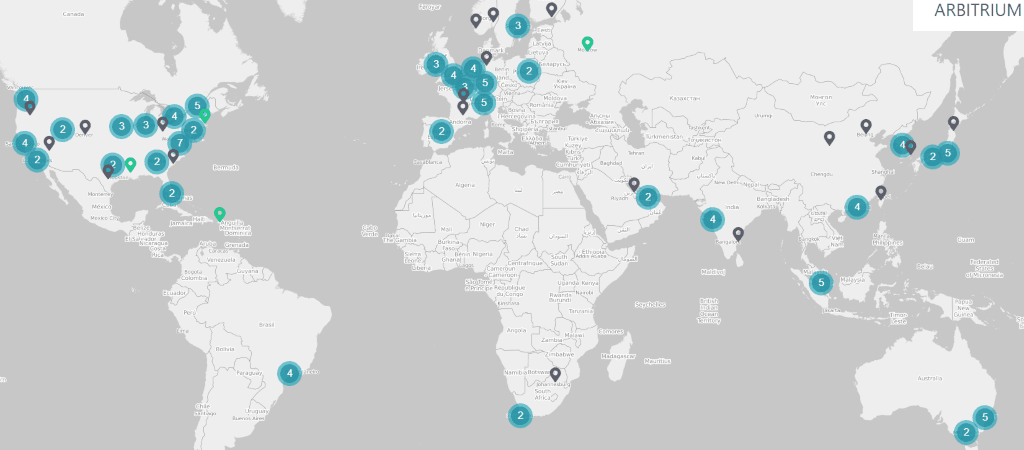
Placement comes in two styles. Region-based hosting runs fleets in a handful of fixed regions and sends each match to the nearest one. Per-match placement chooses a location for each match based on where its players actually are. The first is simpler to run. The second puts the server closer to the players who are about to use it, which matters most when a match mixes players from different places.
How Does Hosting Keep Up With Player Demand?
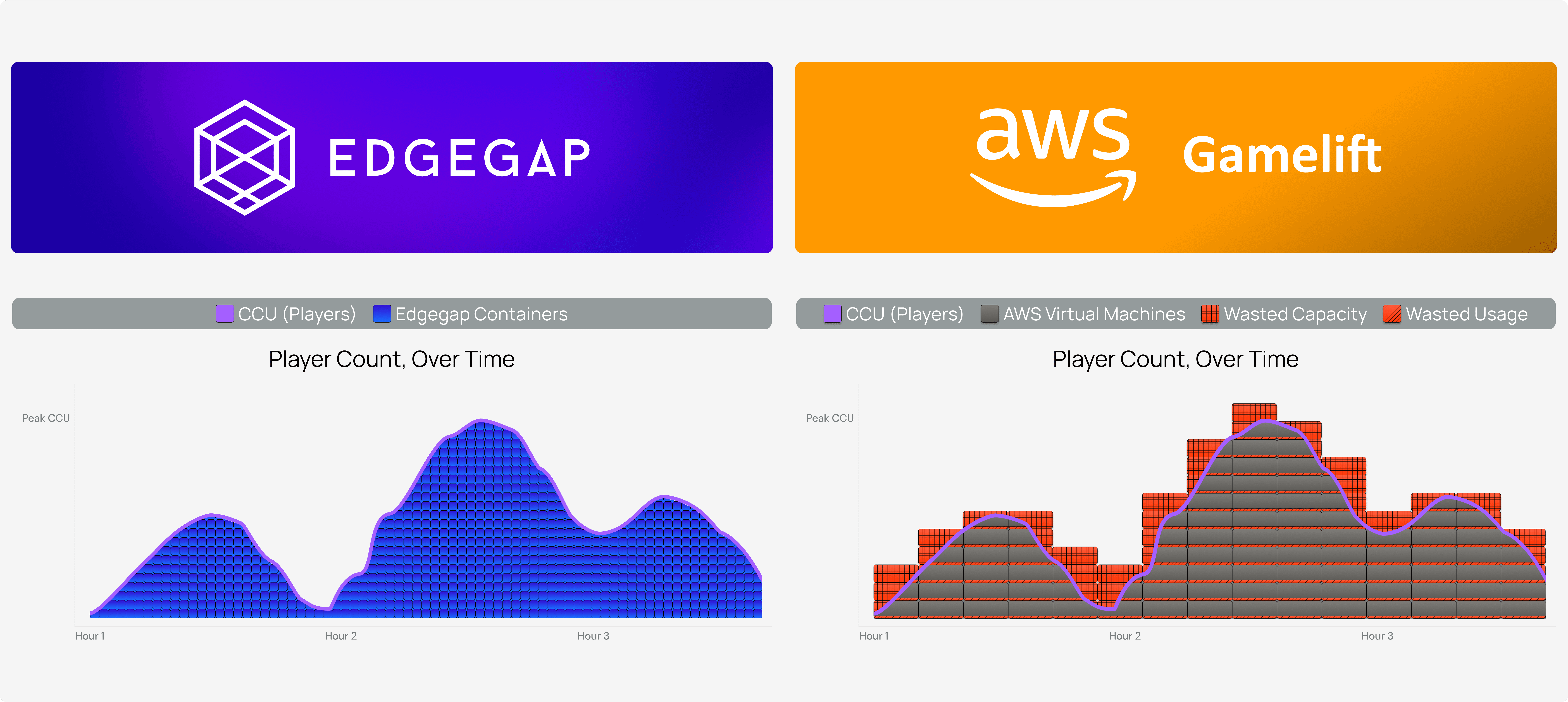
Player demand moves on every timescale: hour by hour, weekend to weekday, and in spikes nobody scheduled, such as a launch, a sale or a streamer picking the game up. Too little capacity means queues at the moment players are most willing to try the game. Too much means paying for servers nobody uses.
The common answer is to split demand in two:
Reserved capacity covers the baseline: the players you can count on even in your quietest hours. It is far cheaper per core when it is full. On Edgegap, a private fleet vCPU costs $0.0256 per hour (platform data, last updated 30 September 2026), and private fleet hosts are egress-free, which removes the bandwidth line that grows with every connected player.
On-demand capacity covers everything above the baseline, billed only while it runs: $0.00115 per vCPU per minute, or $0.069 per hour, on the same page.
Sizing the split is iterative. Our private fleet documentation recommends starting with a conservative baseline and letting overflow absorb the spikes, then adjusting as real traffic comes in.
The split is not the only valid shape. A persistent world with a steady population can run entirely on reserved machines. A game heading into an unpredictable launch, or one with sharp daily peaks and quiet nights, can run entirely on demand until its baseline becomes clear.
Should You Build Your Own Game Server Hosting?
Building your own means owning more of the four layers for a game that has to serve players across the world, around the clock: contracting machines in every region you need, and building orchestration on top, often with Kubernetes and Agones, the open-source game server project started by Google and Ubisoft. What you gain is control.
What you pay comes in three forms.
Engineering. Agones is free to download and expensive to run. One 2026 estimate puts integration at $42,000 and three-year operation at up to $567,000, before counting the tooling studios add around it (The Hidden Cost of Studio Engineering: Agones, using Deconstructor of Fun's cost calculator).
Idle capacity. Agones, like most self-built setups, is fleet-based: it keeps servers running and ready before players arrive, in every region, and those waiting servers are billed whether or not a match ever lands on them.
Buying power. A single studio negotiates with each provider on its own volume. An orchestrator pools the volume of many studios across many providers and negotiates rates no single studio reaches alone.
Then there is the work nobody budgets: patching hosts, absorbing DDoS attacks, and answering the page when a region fails during a weekend event.
There is a real case for building. A large studio with a steady population, an existing infrastructure team and a long-lived title can make the investment pay back. The risk is speed. Game development keeps getting more competitive, and every layer a team owns is work that ships nothing players can see. Owning the whole stack tends to make a studio slower at exactly the moments, launches and live events, where speed matters most.


A word from our sponsor (ourselves!)
Warm pools make allocation fast because you pay for servers that sit idle. Edgegap provisions a fresh game server in a median of 2 seconds from cold start, measured to container ready before your engine starts, so a server exists only once a match needs one.
How Do You Choose a Game Server Hosting Provider?
Ask about each layer rather than comparing headline prices.
Placement. How many locations are live, and how is a location chosen for each match? Ask for measured latency on real traffic, not a map. Our own figure is a 58% average reduction in round-trip time for dedicated server placement against public cloud, from independent replays of studio traffic (platform data, as of 18 September 2026).
Orchestration. How long does a new server take to become ready, and how much does your game have to integrate? A server packaged as a standard container moves between providers far more easily than one tied to a provider's SDK.
Operations. What is covered: DDoS protection, monitoring, an availability commitment, and who answers at 3 a.m.?
Billing. What is the unit (per server, per vCPU, per player-hour), is egress included, and what commitment is required?
Machines. Last, because containers have largely solved it: a containerized server runs the same way on any host, so specific hardware rarely matters. The exception is a large simulation, such as an MMO with a hundred or more players per server, that needs a particular clock speed. That is usually best served by reserved compute. The Isle, an open-world survival game with 100+ players per server, runs its persistent servers on Edgegap private fleets.
The best provider is the one whose answers match your game's scope, audience and growth curve. That differs between a 1v1 fighter and an MMO.
Edgegap's Take (just our opinion, take it with a grain of salt!)
Spend Your Engineers on the Game
Players never see your orchestrator, your operating system patches or your on-call rota. They feel two things: how far the server is from them, and whether it was there when they pressed Play.
Both depend on access more than ownership. A studio that can draw on a shared pool of on-demand capacity across many providers, and on its own reserved machines where the baseline justifies them, has the infrastructure layer solved on day one, launch spikes included.
What it gets back is time. Every engineer not building a scheduler or answering a 3 a.m. page is an engineer working on what a studio does best: making the game. Building the stack yourself is sometimes worth it. It should be a choice, not a default.
,